
|
Sai Vichaar 01.Feature of the Week: Hold on, even if it is threadbare! 02.Contributed Article:Hindu Worship 03.Experiences of Devotees 04.Devotees Say 05.Sai Activities 06.Prayer Club 07.Quote of the Week 08.Question of the Week 09.From the Editor's Keyboard 10.Subscribe to Sai Vichaar 11.Disclaimer From the Editor's Keyboard... What is worship? One source defines Worship as recognizing and proclaiming the worth, value, majesty, honor and glory of God and giving homage, respect, reverence and praise to God. Worship is one's heart expression of love, adoration, honor, and praise to the Living God with an acceptable attitude and an acknowledgment of His supremacy and Lordship. Prayers are important means of worshipping one's chosen God or Guru. Beneath the apparently physical exercise of ritualistic prayers exist an effective way of communicating with the Guru that gradually leads one to the supreme. With a focus on this aspect of communication with one's chosen God, Sai Vichaar would like to feature a series of articles on Worship as offered by several religions and sectors. Sai Vichaar requests the undivided attention of the readers to the feature "Worship" that begins this week. Worship as seen in Hinduism is featured starting this week. May Sai bless us all. What does one learn from Haji Siddik's story? Humbly yours, The Editor
Disclaimer Sai Vichaar is devoted to the philosophy and teachings of Shri Sadguru Sai Baba of Shirdi, and will take every measure to avoid topics or themes contradicting the same. Sai Vichaar team or the Shirdi Sai Baba web site organization is not
responsible for the opinions expressed by individual contributors.
|
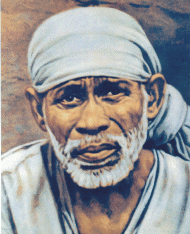 Feature of the week:
Hold on, even if it is threadbare!
Feature of the week:
Hold on, even if it is threadbare!
Human life cannot escape from the power of attraction of the things of worldly nature. Yielding to the stimuli of the world that is so "real" is a course that is only natural. The mind that rejoices over a positive response is the same faculty that repents over something that is not favorable. Those who once had the blessing of realizing self-surrender easily forget the initial resolve, backtracked, only to find them in the same position they have started originally! The staircase of spiritual progression gives away to the slippery mess of self-centered interests. The power of myth is such. Sri B. Hanumantha Rao in "Sai Anusaranamu" wrote that situations such as
the above help us to realize our limitations as human beings. They
reveal our weakness in not being able to deal with the issues of worldly
nature in the right manner. First, it starts with a thought, thoughts
lead to further interest and proceed to stronger wants. Accomplishing
our wants fuel the ego, while the inability to accomplish leads to
anger. More people fall to this trap. When we realize our mistakes, it
is important to seek the divine grace. Sadguru is the guide that leads
us towards this goal. Having faith in Sadguru is the most important
requirement. One must constantly strive to build on the faith that they
have in their Guru. While divine grace is accorded depending on one's
karma, faith in sadguru is entirely a human effort. Hence, it is
important to hold on to the faith, for faith even if weak, is better
than no faith at all. Sai Baba said, "Maya troubles even me, what to
speak of others". Just like a small lamp can drive away the darkness,
faith in Guru will slowly but surely lead to the perennial bliss.
Contributed Article:Hindu Worship The word Puja came from the Dhathu "Puj", which means to worship, to honor, to welcome. The root of the word Puja is "Yaja" Deva Poojaayaam" means the service or activities that one cannot avoid from doing to propitiate or please God. Every country, state, religion, caste, family and even individual has its/their/his/her own belief and ways of performing Puja. Whatever may be the method or system or practice that one adopts or follows, there are, as per Hindu scriptures 4, 5 (Panchopachar), 8, 10 (Dasopachar), 13, 16 (Shodashopachar), 24, 32, 64 or 108 types of Upacharas or activities or services to propitiate God. The daily worship generally consists of sixteen phases or items according to a conventional practice usually referred to as Shodasopachara Puja. These sixteen items are not always necessarily the same throughout. They differ from occasion to occasion and may be from place to place or person to person. But a common sequence popularly followed by majority of the devotees is as follows:
(1) Aavahan or Invocation or Praan Prathishta: We invite the Invisible Supreme Soul to manifest through the idol or photo that we keep in front of us for our prayers or Puja, or we imagine that God is residing in it or we imagine that God manifested in and through the idol or photo accepting our prayers or imagine that the idol or photo has life and God is accepting our prayers through the Idol or photo. (2) Asan or Simhasan or Throne: As we cannot and do not have the capacity to offer a magnificent throne to Lord, Who is the owner of the whole universe, we offer HIM a seat, according to our capacity, thinking that HE feels comfortable, and start decorating it inwardly with all kinds of precious stones, jewels, gold, flowers, cushions, etc., the best we can think of and request the Lord to be seated to accept our offerings. (3) Padyam. This includes the symbolic offering of water for washing the feet. This custom dates back since the days when very few used to wear shoes or chappals and those days without convenient transport facility. Offering water to wash the dust and dirt off the feet. It is also a sign of respect to offer water to wash one's feet. We can see the references to this act in our scriptures, especially with reference to Rishis, Sages, etc. We also do Pada Puja (worshipping the holy feet) to Saints in our houses. (4) Arghyam: As we imagine God has assumed the shape of a human being with two legs, two or four hands, one or more heads, etc., moved by our prayer, we offer HIM water with a feeling that HE would like to wash HIS hands before accepting our offerings, as we do before doing something good or important, sacred or taking food. (5) Achaman: We do Achaman (i.e., we sip water three times with mantras like Om Govindaya Namaha, Om Narayana Namaha, Om Madhavaya Namaha, etc.) facing or sitting towards East to cleanse our inner-self (Antharangam) with the water purified with Mantras, so that any thoughts that we might have entertained either before or after starting Puja will vanish from our mind. Like this, we purify ourselves. As we cleanse our body by taking bath, we cleanse our inner-self by taking water saturated or purified with Mantras. Again here water is offered to God with a view that HE washes HIS face. It is the tradition in our houses that whenever any guest comes from outside, after ushering him into the house, we give him water for drinking as well as washing or at least sprinkling water on the face so that the guest feels relieved of the tiredness and strain of the journey. (6) Snanam/Bath: Bath given to the God with Ganga Jal or milk, or honey, or with perfumed water, etc. (7) Vastra Yugmam: Then we offer good clothes to God and decorate HIM with excellent quality clothes, according to our capacity, as we do to our children on their birthdays. (8) Yagnopaveetam: We then offer HIM Yagnopaveetam, a sacred thread placed across the left shoulder and the right bottom part of the trunk. (9) Gandham: We offer God scented chandan (sandal paste) so as to give
coolness to HIS body. The royal kings used to do this in the olden days.
We offer Oordhwapundram or decorate God with Tilak or some such
decoration to God's face. The next step is Alankar God with Abharanas or
jewels. As we feel that by wearing such and such ornaments, we look
beautiful or we beautify ourselves with all kinds of alankaras, the same
way, we should also feel that the Lord is Self only and we should
decorate HIM with the same feeling and purpose so that HE looks
beautiful.
Kamala Devi
Sathyabhama Sharma, Maryland, USA
S.V. Swamy, Hyderabad, India
Nagalaxmi Yelleswarapu, New Zeland
Madhavi Alaparthy
Kitty, Germany
Ramesh, Australia
Shirdi Sai Baba Mandir, Panvel, India
To all devotees of Sri Shirdi Sai Baba please visit www.surf.to/saibaba and see the messages there to get the daily thought of the day by our Sadhguru Sri Narayan Baba of Panvel. Also you can join the yahoo club to see nice pictures of Sri Sai Baba and Sadhguru Sri Narayan Baba of Panvel Om Sai Ram Shirdi Sai Samsthan USA, Chicago
Saidarbar, Hyderabad, India For further information about Sai darbar and its activities,
please contact: SAIBANISA at saibanisa@hotmail.com
Jeegar
"Baba would accept with appreciation any small thing offered with love
and devotion, but if the same thing was offered with pride and
haughtiness, He would reject it. Being Himself full of Sat Chit Anand
(Existence, Knowledge and Bliss) He did not care much for mere outward
formalities; but if an offering was made in a meek and humble spirit,
the same was welcome and He accepted it with pleasure and avidity" -
Shri Sai Satcharitha
What did Baba try to teach us through the story of Haji Siddiq Falke?
Haji Siddiq Falke had to wait for nine months after his pilgrimage to
Mecca and Madina. The seed of purity planted in Mecca and Madina needed
that time to grow and emerge. Baba wanted to test whether Haji's
humility was real or false. He also wanted to test the Haji's Shraddha
and Saburi. When Baba asked through Shama whether the Haji is willing to
pay Him rupees 40,000 in four installments, the Haji replied that he was
willing to pay even rupees forty lacs! In fact, it was Baba, who often
said that He has to give 10 times or hundred times what He takes from
devotees. Here, the Haji, out of his ardent devotion or out of pride,
offers 100 times what Baba asked! Similarly when Baba asks him whether
he wants the haunch or the testicles of the goat, the Haji, 'humbly'
replies that he will be satisfied with a small crumb from Baba's
Kolamba. While to all present, this may appear as utmost humility,
probably only Baba knew that there was a small seed of pride concealed
deep down. Even the Haji was probably not conscious of it. So it had to
be first brought up and then destroyed. This pride, Baba demolishes by
shouting at him, "Why do you brag and fancy yourself great and pose
yourself as an old Haji? Do you read Quran, like this? You are proud of
your pilgrimage to Macca; but you do not know Me." After admonishing the
Haji thus and destroying his ego, Baba accepted him. Thus the lesson
that we can learn from this very significant story is that the
'greatest', 'purest' or 'humblest' of the Sadhakas may, without their
own knowledge or awareness, be tainted by ego, pride. Only a Sadguru can
see our innermost secrets and destroy the weeds or cancers. And on our
part, Shraddha and Saburi are the only requirements for Sadguru's grace
to dawn on us.
|

© 1996-2001 by saibaba.org, all rights reserved.
