
|
Sai Vichaar 01.Feature of the Week: Spiritual Oasis 02.Contributed Article:Hindu Worship-Part IV 03.Experiences of Devotees 04.Devotees Say 05.Sai Activities 06.Prayer Club 07.Quote of the Week 08.Question of the Week 09.From the Editor's Keyboard 10.Subscribe to Sai Vichaar 11.Disclaimer 12.Submit Articles to Sai Vichaar From the Editor's Keyboard... Sai Vichaar along with Sai devotees mourns the tragedy that struck Gujarat, India last month. May Baba’s mercy be on those suffering through this calamity. Let us all keep the victims in our thoughts and prayers as we painfully move through the difficult days. Sai Vichaar anounces the publication of a crossword puzzle on the life and teachings of Lord Sainath through HIS grace. It is hoped that this well known method of mind engagement will keep Baba's thoughts in mind and HIS life in focus as the devotee tries to solve the puzzle. We ourselves being limited in knowledge, seek forgiveness if there are any errors or ommissions in the puzzle. To get to the crossword puzzle, please visit the Crossword page. The "Question of the week" for this week is, "Which ancient sacred teaching did Baba help Das Ganu to understand and what is its significance" ? Humbly yours, The Editor
Disclaimer Sai Vichaar is devoted to the philosophy and teachings of Shri Sadguru Sai Baba of Shirdi, and will take every measure to avoid topics or themes contradicting the same. Sai Vichaar team or the Shirdi Sai Baba web site organization is not
responsible for the opinions expressed by individual contributors.
|
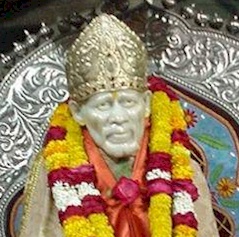 Feature of the week:
Spiritual Oasis
Feature of the week:
Spiritual Oasis
Sapatnekar was an elite lawyer who did not quite believe in Baba until he had to face the calamity of losing his only son to disease. Disinterested in life and disturbed, he had to seek in refuge in Baba. Nanasaheb Chandorkar had his own questions about the all pervasive nature of Baba. Baba revealed Himself to Nana through some of the divine experiences of the latter, and thus Nana was a part of Baba's court. Kakasaheb Dikshit, another ardent devotee of Sainath did not know about Baba for several years and Baba drew him towards Himself via peculiar circumstances. Hemadpant wrote that however scholarly may man's learning be, it just
fades away in front of the one that realized the Brahman. Everyone one
of those that approached Baba with a preconceived notion, either with
the curiosity to know if He is really what He is being portrayed as or
with the arrogance of learnedness had to bow in front of His humility,
benevolence, compassion, and the magnificence. In case of all those
learned men, it was the surrender either due to the misfortune of a
suffering or the providence of His grace, that provided them with the
means of enlightenment. It is true that however scholarly may man's
learning be, it just fades away in front of the one that realized the
Brahman. On this peaceful Thursday, let us contemplate on that
realization only a Sadguru can give and nothing else the world may teach
will.
Contributed Article:Hindu Worship-Part IV The absolute God cannot be grasped by the human mind, so we require symbols. If the devotee is very philosophical man, his symbol may be very abstract in nature: a vast expanse, the infinite sky, something unlimited. These are other images and conceptions, though subtle. A person who cannot think in an abstract way prefers to have more concrete symbols. So he has been given forms of the anthropomorphic type. This is consistent with the three major conceptions of God: God the Absolute; the personal God with qualities, such as kindness and love, but no form; and the personal God with both form and qualities. In Hinduism, we find that the personal God has not only qualities, but a variety of forms as well. And why should this not be so? From a psychological point of view, the ideal needs to be presented according to the understanding of the devotee, all the while reminding him that it is through the worship of the form that he is to reach the formless aspect of the divine. This is the idea behind image worship in India. Image worship does not mean that some inert substance such as wood or stone is being worshipped. The image is also not a mere icon. It is a symbol of the lord. It reminds the devotee of the Lord, just as a photograph reminds us of the thing photographed (Ref. "Concept of God in Hinduism" by Swami Swahananda from The Vedanta Kesari, February 2000) The idol is a support for us in spiritual childhood. A form or image is necessary for worship in the beginning. It is an external symbol of God for worship. It is the reminder of God. The material image calls up the mental data. Steadiness of the mind is obtained by image worship. The worshipper will have to associate the idea of infinity, omnipotence, purity, perfection, freedom, holiness, truth and omnipresence. It is not possible for all to fix the mind Absolute. A concrete form is necessary for practicing concentration. To behold God everywhere and to practice the presence of God is not possible for the ordinary man. Idol worship is the easiest form of worship for the modern man. Idol worship is not just limited to Hinduism. Christians worship the Cross. They have the image of Cross in their mind. The Muslims keep the image of the Kaaba stone when they kneel and do prayers. The people of the whole world keep some image or the other in their mind. The mental image is also a form of idol. Everyone is thus idol worshipper. Pictures, drawings, symbols etc. are all forms of idol only. Idols are not the idle fancies of sculptors, but are shining channels through' which the heart of the devotee is attracted to God and flows towards him. Many would say, "Oh God is an all pervading formless being and how can God be confined to this idol!" Are these people ever conscious of His omnipresence? Do they always see Him alone in everything? No, It is their ego that prevents them from bowing to the idols of God and with that motive, they put this excuse forward. The idol is a substitute or symbol. The image in a temple though it be made of stone, wood or metal is precious for a devotee as it bears the mark of his Lord, as it represents something which he holds holy and eternal. A flag is only a small piece of painted cloth, but to a soldier it stands something that he holds very dear. He is prepared to give up his life in defending his flag. Similarly, the image is very dear to a devotee. It speaks to him in its own language of devotion. The image arouses devotion in the devotee. A piece of ordinary white paper or colored paper has no value. We throw it away. However, if there is the stamp of Government on the paper (currency note), we keep it safe in pocket. Even, so an ordinary piece of stone has no value for us. We throw it away. However, if we behold the stone idol, we all bow our heads with folded palms, because there is the stamp of beloved lord on the stone. When you worship an image, we do not say; "this image has come from Punderpur. It was bought by Shriram. Its weight is 50 lbs. It is made of white marble. It has cost me Rs. 500/-" No! We superimpose all the attributes of the Lord on the image and pray. When our devotion and meditation become intense and deep, we do not see the stone image. We behold the Lord only who is pure Consciousness. Image worship is very necessary for beginners. By worshipping the idol,
the Lord is pleased. The idol is made up of the five elements. The five
elements constitute the body of the Lord. The idol remains an idol, but
the worship goes to the Lord. If you shake hands with a man, he is
highly pleased. You have touched only a small part of his body and yet
he is happy. He smiles and welcomes you. Even so, the Lord is highly
pleased when a small portion of his cosmic body is worshipped. An idol
is a part of the body of the Lord. The whole world is His body. The
devotion goes to the Lord. The worshipper superimposes on the images the
Lord and his attributes. This is one of the easiest forms of
self-realization. It is one that suits the majority of people today. A
look at the picture of God will elevate our mind to divine heights. This
is truly a wonder and a miracle.
Lata
Saibanisa, Saidarbar, Hyderabad, India
Sri Shiridi Saibaba Bhaktha Samajam, Peapully, Kurnool, AP, India.
Saidarbar, Hyderabad, India
A Sai devotee
Sai Bhakth, Milford, CT
Sangeetha
Ramesh, Boston
Mukund Raj, USA
"He who sees ME in all creatures is my most beloved" - Sai Baba
Q.What did Baba teach us through the wrestling bout with Mohdin Tamboli?
The episode of Mohiddin Tamboli in Chapter 5 of Sri Sai Satcharitra, page 27 (English version by Sri Gunaji), is a very interesting and instructive episode. Baba was fond of wrestling. Once He and Mohiddin Tamboli did not agree on some point and then they had a wrestling match in which Baba was defeated. This caused a major change in His lifestyle. He started wearing a Kafni, a Langot and had His head shaved and was covering it by a cloth, which draped down His shoulder, like matted hair. Something similar is described about another saint Ganga Gir. What is the significance of this wrestling match? Why did Baba 'allow'
Himself to be defeated by Mohiddin Tamboli? It is clear that He enacted
this drama with some purpose. If He wanted, He could have easily
defeated not one but 10 Mohiddin Tambolis. After all, He had perfect
control over the elements by that time, as demonstrated to Chand Patil.
So He had some definite purpose. What was it? Baba wanted to lead by
example. Most of us are fond of our looks, and most of us want to win
over others, either physically or mentally. Thus either through good
looks, or good education, through muscle power or money power, we want
to dominate others. Baba showed by this episode that sooner or later, we
will meet someone better than us and are bound to lose. At that time, do
we accept our loss with equanimity? Certainly not! When we win we are
elated, when we lose, we are depressed. We try to regain our lost pride
by either deprecating the winner, or by taking out our frustration on
someone less powerful . Thus, as long as we try to win over someone by
any means except selfless, true, altruistic love, we are bound to lose
and suffer. He changed His external lifestyle to emphasize this point
and to sanctify the poor, the meek and the humble, so that the more
fortunate and powerful brethren do not try to dominate them. He started
openly advocating Fakiri, Mendicancy etc., only to drive home the point
that all that we think is ours is actually the Bhiksha of God. That is
why He always used to say "Allah Malik" meaning God is the Owner. And
that is also the reason, Baba discouraged discussions and arguments.
There is more to this. Baba wanted to teach all of us one important
lesson. Even if we are able to win over all others in the external
manifest universe, we will certainly not be able to win over our
internal enemies! And we have not one but at least six of them! (Kama,
Krodha, Lobha, Moha, Mada and Matsarya). And we have our ego, which is
the most difficult enemy to conquer! So, Baba's message to all of us
through the interesting and spiritually uplifting and instructive
episode of Mohiddin Tamboli, is: " Don't fight! Surrender! Surrender not
to your enemy but to your God and Guru, who will then take care of your
enemies!"
|

© 1996-2001 by saibaba.org, all rights reserved.
