
|
Sai Vichaar 01.Feature of the Week: Maha Sivarathri 02.Contributed Article:Hindu Worship-Part VI 03.Experiences of Devotees 04.Devotees Say 05.Sai Activities 06.Prayer Club 07.Quote of the Week 08.Question of the Week 09.From the Editor's Keyboard 10.Subscribe to Sai Vichaar 11.Disclaimer 12.Submit Articles to Sai Vichaar From the Editor's Keyboard... Sai Vichaar announces the publication of a crossword puzzle on the life and teachings of Lord Sainath through HIS grace. It is hoped that this well known method of mind engagement will keep Baba's thoughts in mind and HIS life in focus as the devotee tries to solve the puzzle. We seek forgiveness if there are any errors or omissions in the puzzle. To get to the crossword puzzle, please visit the Crossword page. Please send your suggestions and comments to Sai Vichaar. It is learnt that Sai Vichaar has been featured as the recommended free weekly Newsletter by the web site www.rediff.com, in the "Spiritual" category. Such a recognition is not possible without Sadguru Sainath’s grace and the support of ever growing number of devotees across the world. Sai Vichaar is humbled and thankful for the support. The "Question of the week" for this week is, "Why is it Baba bemoan the loss of the brick?" "Which ancient sacred teaching did Baba help Das Ganu to understand and what is its significance" ? Humbly yours, The Editor
Disclaimer Sai Vichaar is devoted to the philosophy and teachings of Shri Sadguru Sai Baba of Shirdi, and will take every measure to avoid topics or themes contradicting the same. Sai Vichaar team or the Shirdi Sai Baba web site organization is not
responsible for the opinions expressed by individual contributors.
|
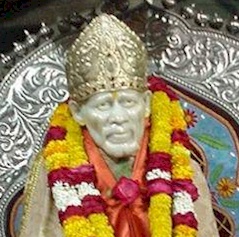 Feature of the week:
Maha Sivarathri
Feature of the week:
Maha Sivarathri
Maha Sivarathi, the night of Lord Siva, is an important festival in Hindusim. Celebrated on the moonless night of the month of Phalguna, which is fourteenth day in the dark half, this festival is specially dedicated to Shiva, the destroyer. This is an important day for the devotees of Shiva, who stay awake throughout the night, praying to him. On 14th night of the dark half of the month, the moon is scarcely visible, symbolizing the existence of the mind. As the object of all spiritual effort is the complete dissolution of the mind (as a pre-requisite to self-realization), the all night vigil with fasting, bhajans, japa, dhyana, on Sivarathri night represents that extra effort of the spiritual aspirant. Such effort can result in the complete conquest of the mind, symbolized by the disappearance of even the little bit of the moon on the following New Moon night. Maha Sivarathri is particularly celebrated with fervor amongst the followers of Lord Siva. A fable as follows represents the significance and the power of this festival; Once upon a time, there was a hunter set out for a hunting. He had upon himself a big burden of feeding his starving wife and children. He came near a pond, and for the purpose of hunting he climbed a "bel" tree (sacred to the Lord Siva). Sitting on a branch he waited for the prey. As the leaves obstructed his vision, he began to pluck a few leaves, which by chance fell on a Siva Linga ("pindi"), that happened to be under that tree. Then a herd of deer came to drink water. The hunter took aim at a hind (female deer). But as she noticed the movement of the hunter, she cried out, "Please, wait a moment, before you shoot let me go home and meet my young ones for the last time. You may shoot me afterwards at your pleasure." The hunter gave the hind permission to go home, and remained sitting on the tree waiting for her to return. Waiting the whole night he was forced to observe fast. Because he was hungry, he could not sleep. As a way to alleviate the long unappeased hunger, he began singing to himself On the Siva Linga he had inadvertently offered the "bel" leaves. With his mouth he uttered the name of Siva, thus he fulfilled the conditions needed for the observance of the Maha Sivaratri. So without knowing how, his heart was changed and he was filled with sentiments of mercy. Before dawn the mother deer came back with the entire herd. "Now you may take my life at your pleasure" she said. Seeing the hind’s honesty the hunter’s heart was further softened, and he completely gave up his thought of killing the hind. Lord Shiva was so pleased with the transformation of the hunter and the truthfulness of the deer, He appeared before them thus grating them all salvation. According to the Siva Purana, the great Epic of Lord Siva, the Mahashivaratri worship must incorporate six items: the ceremonial People offer the cooling bel leaves to the hot-blooded deity bath representing purification of the soul; the vermilion paste applied on the linga after bathing it, representing virtue; food offering which is conducive to longevity and gratification of desires; incense, yielding wealth; the lighting of the lamp which is conducive to the attainment of knowledge; and betel leaves marking satisfaction with worldly pleasures. Lord Sai was Siva to His followers. As the blessed Megha would have done
it, let us during this holy period, remember the benevolence of Sai
Siva, and seek His coffers.
Contributed Article:Hindu Worship-Part VI
Shri Sri Yogananda Paramahansa said, "When an offering is made of
flowers or incense or flame from oil lamps or candles on the altar, they
represent the devotion of man to God. The flowers symbolize the fragrant
love of the devotee; the incense conveys reverence; the flame typifies
the light of calmness in which is revealed the Divine Deity, residing on
the altar of the heart"
One may see the ritual of worship not as a mere physical exercise but as
a real means through a communication between the self and the supreme is
established. Understanding of such a communication is essential to reap
the harvest of spiritual benefits.. Rituals may not be limited to the
act of reinforcing one’s stance on earth, a religious identity. It
should be the vehicle that leads one to the understanding of the entity
that is fundamental to the origin of all religions. Such a communication
can only be unifying and not divisive. This series may be aptly
concluded by a quote from Ishopanishad, the mention of which is also
made in Sri Sai Satcharitha:
God is omnipresent and HE owns this universe. We should, therefore,
enjoy it with a feeling of sacrifice, to the extent that is necessary
for us and the rest should be left to others in the society and never
ever feel jealous of others.
The readers are also requested to visit
http://www.mantraonnet.com/practices.html. for a good collection of
explanations for different questions pertaining to the spiritual
practices followed in Hinduism.
A Sai devotee
Seema Pahwa, Dix Hills, NY, USA
Sudhakar, Minnepolis, MN
Jayakiran, Sacramento, CA
Veena Gupta, New Delhi, India
Sri Shirdi Sai Sansthan,Sydney, Australia
Shirdi Sai Center, East Brunswick, New Jersey, USA
Achuta Ramaiah
Kameshwari Kollarapu
Muthu
"The proof of pudding is in the eating. Baba must be treated as God for,
by treating him so, persons found and find that they derived and derive
adequate benefit, the same benefit they would derive by worshipping God.
This is sufficient proof that Baba was and is God. Many acted and act on
that faith. Myriads affirmed and affirm Baba was God and Baba is God.
The special features of Baba should be seen not with ordinary eyes but
with eye of devotion and love. Seen with ordinary eyes, Baba was a man
and a poor fakir living in a dilapidated mosque, but seen with an eye of
devotion, Baba was God or a Guardian angel" - H.H. Narasimha Swamiji
Q."Which ancient sacred teaching did Baba help Das Ganu to understand and what is its significance"? A. (By S.V.Swamy, Hyderabad, India) With reference to the Question of the Week in SaiVichaar, I submit the
following. Sai Ram. Sri Dasganu Maharaj was an ardent devotee of Sri Sai
Baba and was 'instrumental' in spreading the name and fame of Sai
Maharaj with his Kirtans. He was also an author of two books, 'Bhakta
Leelamrut' and 'Sant Kathamrut'. Presumably he wrote these two books in
Marathi. From Sri Satcharitra, we also know that he was trying to
translate and write a commentary 'Sri Isha Upanishat' in Marathi. Shri
Hemadpant explains how brief this Upanishad is (just 18 slokas). It is a
well-known fact that the shorter the original message, the more cryptic
it will be. And when we try to magnify a small object into a big object,
a lot of distortion will normally get introduced. So, when Sri Dasganu
Maharaj did not feel satisfied with his intellectual efforts and when
his consultations with other 'learned' scholars did not satisfy him, he
turned to his 'Sadguru' Sri Sai. And Sri Sai did solve Dasganu's
difficulty through Kakasaheb's maid servant. The message which Dasganu
got is that the whole world is God's form and He is all pervasive. And
that one must accept in humility what one is bestowed with by God. Why
Sri Dasganu did not think of approaching Sri Sai in the beginning itself
and when he did finally approach, why Sai sent him to Vile Parle to the
house of Sri Kakasaheb instead of explaining the philosophy? It is one
more of His Leelas. Sri Dasganu Maharaj got a practical demonstration of
the teachings of Sri Isha Upanishad. And why did he not think of asking
Sai in the beginning? He had to learn and experience the lesson that
learning fades before self-realization! In fact, that seems to be the
real lesson which Sai taught him. Sai Ram.
|

© 1996-2001 by saibaba.org, all rights reserved.
