
|
Sai Vichaar 01.Feature of the Week: Miracles of the Portrait! 02.Contributed Article: Why Saburi? 03.Experiences of Devotees 04.Devotees Say 05.Sai Activities 06.Prayer Club 07.Quote of the Week 08.Question of the Week 09.Subscribe to Sai Vichaar 10.Email Newsletter to a friend 11.Submit Articles to Sai Vichaar 12.Un-Subscribe Sai Vichaar 13.From the Editor's Keyboard 14.Disclaimer From the Editor's Keyboard...
The "Question of the week for the week" is, "What did Baba convey us through the experiences of Mrs. Khaparde in Sai Satcharitha?" Humbly Yours, The Editor
Disclaimer Sai Vichaar is devoted to the philosophy and teachings of Shri Sadguru Sai Baba of Shirdi, and will take every measure to avoid topics or themes contradicting the same. Sai Vichaar team or saibaba.org is not
responsible for the opinions expressed by individual contributors.
|
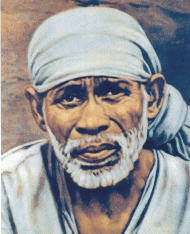 Feature of the week:
Miracles of the Portrait!
Feature of the week:
Miracles of the Portrait!
The magical power of Sainath's portrait is indisputable. The saintly figure with the compassionate eyes as portrayed by blessed Jayakar draws millions of devotees and stays as the single most revered pictures of Sai Baba of Shirdi. Hemadpanth is credited with the beautiful description of Baba's posture in Sai Satcharitha; true, it is the beauty of thousand moons that Sainath reveals between His parting fingers! Hemadpant narrates several incidents about Baba's appearance in the form of portrait to those who intended to receive Him into their hearts. Appearing in the form of portrait was also Baba's assurances of His presence and blessings to the devotees. Baba gave darshan to Shama in the form of a big portrait at the dormitory in Gaya during the former's visit. Thus, Baba had kept His earlier word to Shama that he would be ahead of Shama after doing Banaras and Prayag. In another incident Baba attended the family function at Hemadpant's house in the form of a portrait. Sai Satcharitha narrates the chain of events that led to Baba's appearance as a portrait, in the process fulfilling His assurance to Hemadpant. Portraits and pictures of Baba are at the least the signs of His omnipresence. They represent the universal love, compassion and merciful bounty of Baba's treasures. In commemoration of the essence of Shirdi Sai Baba's message of universal
goodwill and the Omnipresence of the Divinity, saibaba.org announces Shirdi
Sai Baba Chitra Yatra: 2002 commencing from January 2002. The Chitra Yatra
is being organized in USA to bring peace and to invoke Shirdi Sai Baba's
blessings for the benefit of devotees all over the country. He who inspired
millions during His life continues to be a beacon of spiritual
enlightenment even today and the objective of this event is to spread His
message to the ever-growing numbers drawn to the spiritual path. Let us on
this Thursday, contemplate on those beautiful stories of Sai Satcharitha
and pray that Baba would provide the same happiness and satisfaction to the
participants of Shirdi Sai Baba Chitra Yatra. Please visit
Yatra page for more details.
Contributed Article: Why Saburi?
We are all familiar with being stuck on the road (while driving), because
there has been an accident somewhere on that road. It takes away the fun
out of driving. It feels unbearable to either stand still or keep on doing
stop and go, when you are very tired after a full day of work and want to
go home and relax. If you are driving to the airport to catch a flight, the
mental agony you undergo while stuck on the road cannot be described in
words. If you finally miss the flight, then it would become not merely an
inconvenience but may indeed a problem. When one thinks about it, the root
cause of most accidents that happen on the road is impatience; it is not
malfunctioning of a vehicle. People do not want to observe speed limits,
why, they want to go faster. They want to overtake others when they are not
supposed to, why, they cannot wait for a few seconds to make the right
move. They do not want to wait for the light to turn green. They want to
run through yellow lights because even if the light turns red while they
are in the intersection, it would still be legal to go forward. So, they
make an accident and sometimes get seriously injured, or even die, or if
not at least get stopped by the police and most of all, stop hundreds of
drivers on the road for hours. By being impatient, they not only cause
trouble for themselves but a lot of aggravation to many others. Such are
the consequences of impatience. Suppose that in such a situation, a police
is directing the traffic. When I am in one lane, because I am tired of
waiting, it appears to me as though the police is letting the traffic in
the other lane go, or traffic in the opposite direction go but is not
allowing the traffic in my lane to clear equally often. If I now become
impatient, and try to drive out of my lane without instructions from the
police or go to the police and yell at him or argue with him for being
unfair because I did not cause the accident and I did not deserve that
plight, what does the police do? He may just send me back if he is nice, or
give me a ticket or fine me. Therefore, impatience does not help even
though I am not at fault. Ego is the basis for impatience. Even though the
police are trying whole-heartedly to help, my show of impatience will not
please him because he senses arrogance behind it. Nobody likes any other
person throw temper tantrums at him/her. We cannot tolerate egoistic
behavior of others but surprisingly, we expect Sai to tolerate our ego and
impatience. Often, actions of one person have consequences for not that
person alone but for many others, particularly so, if that person is in
power. Those in power start all wars but many many people suffer as a
result. Senior managers in corporations cheat because they want to make
money fast and employees suffer by losing jobs. Being impatient and blaming
Sai is not fair, because He is directing the traffic stuck on the road like
the police.
(Contributed by Shyamala Hari)
Nandini Sriram
Swati
Ketna
My family thought there was something I was not telling them, they thought something terrible had happened to me as if I was pregnant. I told them I did not know why I was feeling like this. I was going mental, I just wanted to sit on my bed in silence and do nothing. My mother then decided to take me to the Sai healing centre in Leicester (U.K), there a very strong Sai devotee who speaks to Baba told her that someone had done witchcraft on me. She healed me and gave me vibhuti to take with water. When I went to a Sai temple, I concentrated on the murti of Shirdi Sai Baba. Suddenly, I started crying like a baby for no reason and I could not stop. My whole body was shivering and I could not stop it. When a devotee gave me some vibhuti in water, I stopped. Ever since, I feel like my self now. I thank Sai Baba and love him very much. I hope helps everyone like he did with me. Swapna
Bharathi Kunigiri
Sathya Sharma, Maryland, USA
Neelu
Shalini Agarwal
Vivek Gupta, Mumbai, India
Derek Harrison
Quotation of the Week
Q. Why did Baba bemoan the loss of the brick?
Early in October 1918, Madhav Phasle lifted the brick and carelessly allowed it to fall, whereby it broke into two. Baba, seeing the broken pieces, expressed his grief and said, 'My fakir's wife left me with Venkusha at Selu. I stayed with him for 12 years, and left Selu. This brick [which Baba always lovingly used to support his arm or head] is my Guru's gift, my life companion. It is not the brick that is broken now, but my Karma [prarabdha] that has snapped. I cannot survive the breaking of the brick.' "Baba viewed the breaking of the brick, here represented as Venkusha's Gurudiksha, as ominous. This is confirmed by Mhalsapati's testimony. Baba asked, "Who broke the brick" Mhalsapati mentioned that Madhav Phasle had broken it. Then Baba got very angry with Madhav, and placed his hands on his own head and felt extremely sad. Baba said, "Sobat tutli." i.e. the companion is broken. "Next day Kaka Dikshit came and said there was no need to deplore the breaking, as he would join the pieces with silver joints. Baba said, 'Even if you join them with gold, what would be the use This brick is my "Sobatya" [companion from his Selu days] and its breakage betokens evil.' "From that time onwards Baba was dispirited. At least that is what Mhalsapati thought." Sri Sai Satcharita gives the same story with slight variation. It does not mention that Baba became angry, but he bemoaned and cried over the breaking of the brick. What I like in the spiritual journey does the freedom of thinking and freedom of interpretation, according to one's own understand. While reading this story, the first question came to mind was about the significance of the brick. My thought process started like this. A potter takes a ball of clay in his hands and skilfully gives a shape to clay. Then he bakes it in the fire until it is fully baked. And after cooling it, he presents in the market. Similarly, a sishya goes to a guru as a raw material, like clay. Guru gives shape to this clay with utmost care and incomparable skills until he is satisfied with his creation. Then he bakes it in the fire of knowledge and tests how his sishya withholds the heat. Once convinced of perfection, he presents the sishya to the world for "Bahu jan hitaaya, bahu jan sukhaaya" i.e. for goodness of many, for happiness of many. Sri Venkusha shaped the clay and baked his brick for twelve years before he presented his perfect disciple to the world. [Here, of course, the 'clay' was of rare kind and so was the guru.] The brick is also breakable representing the vulnerability of one's spiritual and mental composition. Thus reminding how one has to remain conscious of each action and thought in one's day-to-day life. Sri Venkusha gave the brick to Baba as a symbolic gift. Baba used the brick for resting his head or his arm. This again indicates that he constantly remained in touch with his guru. He rested his head on the brick as if he was putting his head at the Lotus feet of his guru. Mhalsapati also mentioned that when Baba came to know about the broken brick, he put his hands on his own head and said, "Sobat tutli". Why did Baba put his hands on his own head in one of the ways of meditation, guru is symbolically placed on the head during meditation. Avatars like Sai Baba are always absorbed in constant meditation even while mixing with people and guiding them. Here, perhaps Baba by putting his hands on his own head touched the feet of his guru and sadly expressed to him that he lost his [guru's] constant companionship and protection. Baba cried because the broken brick meant separation from his guru. That was why he said that he could not survive without the brick. Q. What does Baba convey through Mrs Khaparde's experiences?
A perfect example of Guru-Disciple relationship was conveyed by Baba
through Mrs Khaparde. She was faithful, devout and loved Baba deeply. Every
noon, she brought naivaidya for Baba and only after Baba had it did she
have her lunch. Such was the power of her devotion. She performed her daily
duties sincerely without any expectations. Lord Krishna says in the Geeta
that if a devotee offers the Lord a drop of water with great devotion, that
will please him the most. Baba was also conveying the same message. Another
interesting aspect was that Baba knew her for a long time through several
births. By explaining as to how long he knew her, he has confirmed the
theory of having a rebirth based on your good deeds (karmic Theory). I
think the most important message conveyed was a disciple or a devotee
should have BLIND DEVOTION and FAITH towards the Guru or God. Sairam.
Shri Shirdi Sai Chitra Yatra 2002 in USA organized by saibaba.org
* Invoking nationwide prayer for peace and prosperity for all. How can one Participate: Host Home: Participate by being Host to Baba. Baba's picture can be brought from a Chitra Yatra Anchor Home close to you and return the picture to the Anchor home. Prayers can be offered either alone or in groups in whatever way one pleases. Help and guidance is available for those who want to perform archana, arathis, bhajans, parayan, etc. though it is not necessary. One can spend time in meditation while the picture is at home. What is most required is love and devotion while praying. Anchor Home: Participate by being an Anchor Home to Baba. An anchor home will receive Baba's portrait and other material(like books, etc) from saibaba.org and will be responsible for keeping Baba for a prolonged time e.g. 4 to 6 months. Will help to propagate the message to others in the community by letting friends and family know about the Yatra to enable them to be a Host home. Send and receive portrait to and from Host homes. Take care of Baba with love and devotion as long as Baba has to stay in the Anchor home i.e. till it is time to go to another Anchor home or to be returned to Chicago. Provide help to other host homes and coordinate with those who want to volunteer. Provide continuous feedback to saibaba.org regarding the activity while Baba is at the anchor home. Help and guidance is available at all times. Volunteer: Good for students, singles and others who don't have the inclination or resources for participating as a Host or Anchor home but would volunteer themselves at prayer meeting in other Baba devotees home or volunteer to drive Baba's picture from place to place or help in propagating the Yatra information through distributing flyers and posters to the local community via Grocers, temples in your area. Donor: Good for people who can't participate any other way than voluntarily contributing financial support for the event. This is not a fund raising activity but if this is the only way one can participate, one will not be excluded. All donations are tax deductible. Seek your accountant advice on donation limits and other details. The yatra is open to all and will start on Jan 1, 2002 from four corners of USA and will proceed till later part of the next year. The Yatra will end based on the overall response from the participants. The closing ceremony and dates will be announced next year. Hope the information is enough to give you an idea of the concept and help you decide your level of participation. If you have any questions, please contact by email at yatra@saibaba.org or call us at (847) 931-4058. Please do register yourselves early to enable us to work on the logistics. Any activity is only successful by active participation of all those involved. We invite you to be an Anchor home in your area and involve your family and friends that are close to you. Please do not hesitate to send us your comments, questions, concerns and suggestions.
For more information please visit http://www.saibaba.org/yatra/saiyatra.html. Register
now online or download the registration form and send it by fax, email or snailmail.
|

© 1996-2001 by saibaba.org, all rights reserved.
